Beanie Fresh: A Warm, Playful Display Font for Handmade Creators
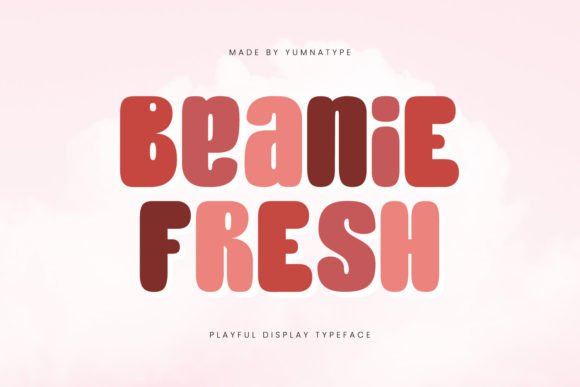
I was sketching candle label mockups on my tablet last Tuesday—amber glass jars lined up beside me, soy wax cooling on the counter—when I opened Beanie Fresh for the first time. Instantly, the font felt like a soft hug: rounded, friendly, full of quiet confidence. Not fussy, not stiff, not trying too hard. Just warm, approachable, and unmistakably handmade in spirit. That’s Beanie Fresh: a display font designed to carry personality without shouting.
Each letter is crafted with gentle curves and consistent stroke weight—no sharp edges, no abrupt transitions. The lowercase ‘a’ has a cheerful open bowl; the ‘g’ loops with a relaxed, organic flow; even the capital ‘B’ feels grounded and kind. It’s not a script, but it breathes like one. It’s not a serif, yet it carries subtle editorial warmth. As a display font, Beanie Fresh thrives where attention matters most: names, titles, short phrases, and decorative accents that anchor your design.
I tested it across real production scenarios—label printers, sticker cutters, digital preview thumbnails—and found it consistently legible at 14pt and above. On matte-finish candle labels? Crisp and inviting. On 2-inch kraft paper gift tags? Charming and tactile. For Cricut or Silhouette users, Beanie Fresh cuts cleanly when converted to outlines—no hairline gaps or overlapping nodes, thanks to its well-spaced, open counters and generous x-height. Just remember to always outline text before sending to your cutting machine, especially for small-scale stickers or iron-on transfers.
What makes Beanie Fresh shine isn’t just how it looks—but how it feels in context. When I used it for a set of spring-themed printable planner pages, the font softened the grid lines and made weekly goals feel more encouraging than clinical. On a farmhouse-style wooden sign for a local boutique’s “Handmade With Love” banner? It added sincerity without saccharine sweetness. And for wedding welcome boards—where guests first encounter your aesthetic—it quietly whispered “thoughtful,” “intimate,” and “human-made.”
It’s ideal for short-form impact: product names (“Honey Lavender,” “Midnight Cedar”), shop slogans (“Small Batch. Big Heart.”), greeting card headlines (“You’re My Person”), or seasonal tags (“Merry & Made”). Because it’s a display font—not a text font—it’s best kept to headings, logos, and decorative elements. Avoid body copy or long paragraphs; its charm lives in brevity and intention.
Pairing Beanie Fresh thoughtfully unlocks even more versatility. I often layer it with a clean, neutral sans serif—like Montserrat or Inter—for contrast and clarity. Think Beanie Fresh for the candle name (“Sage & Smoke”) and Montserrat Light for the scent description below. For wedding invitations, I’ve paired it with a delicate serif (such as Playfair Display) for elegance, or a light handwritten font for RSVP cards—letting Beanie Fresh hold the spotlight while supporting typefaces add rhythm and hierarchy. It also works beautifully solo: on minimalist tote bags, ceramic mug decals, or digital wall art previews where simplicity speaks loudest.
Real-world testing taught me a few practical things. On glossy mug decals, Beanie Fresh holds fine detail without blurring—especially at 20–36pt sizes. For digital downloads (like Canva-compatible printable bundles), it renders smoothly across devices and previews well in Etsy listing images—even thumbnail size—because of its strong letterforms and generous spacing. And for physical packaging—think belly bands, box stamps, or stamped cotton tags—the font translates warmly whether printed in black ink on cream paper or foil-stamped on kraft stock.
Before using Beanie Fresh commercially—whether on physical goods, printables, SVG files, or merch—I always double-check the license. Most reputable display fonts include clear commercial terms, but it’s essential to confirm coverage for your use case: unlimited physical products? digital templates? resale rights for editable Canva files? Also worth scanning: does it include stylistic alternates, ligatures, or multilingual glyphs? Some versions offer swashes or contextual alternates that add subtle flair to initials or quotes—great for invitation suites or boutique branding. File formats matter too: OTF and TTF are standard, but if you’re designing for web-based tools (like Printful or Creative Market templates), ensure WOFF/WOFF2 support if needed.
I’ve used Beanie Fresh on seasonal collections—from cozy autumn tea towel prints to bright summer sticker sheets—and each time, it reinforced a cohesive, human-centered brand voice. It doesn’t scream “trendy”—it feels timeless in the way good craft does. Customers don’t quote font names, but they notice warmth. They feel care in the curves. They remember how something made them smile before they even read the words.
For makers who value authenticity over algorithm-chasing, Beanie Fresh is more than a typeface—it’s a quiet collaborator. It supports your story instead of overshadowing it. Whether you're hand-lettering digitally or prepping a batch of 50 greeting cards, it adds polish without pretense. It fits naturally into workflows: drag-and-drop into Canva, import into Affinity Designer, sync with Adobe Fonts (if licensed), or embed in SVGs for cutting machines.
If you're choosing a display font to represent your handmade shop, ask yourself: Does it reflect how you want people to feel when they hold your product? Does it look as good on a tiny luggage tag as it does on a 24x36” printable? Does it pair easily with other design assets you already own? Beanie Fresh answers yes—to all three. It’s not flashy. It’s not loud. But it’s reliably, warmly, beautifully *yours*.